
Let’s face it: the novelty of traditional AI tools is wearing off. Writing a basic email or getting a quick summary from a chatbot used to feel like magic. But today, it feels like an extra chore. You still have to write the prompt, copy the text, fix the formatting, check it for facts, and manually move it into your work software.
You are still doing all the heavy lifting.
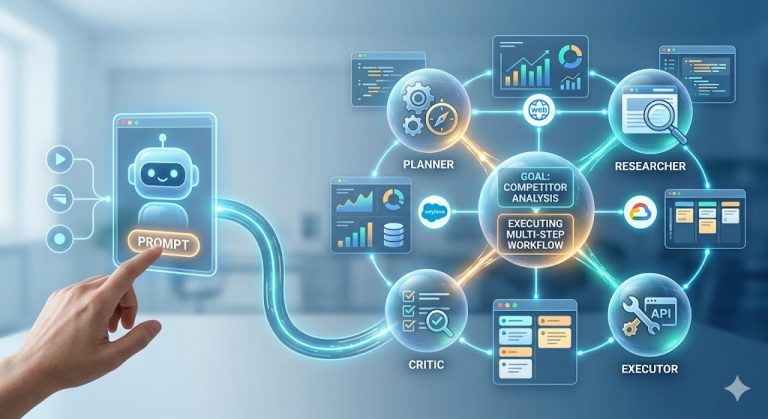
A massive shift is happening in the technology world right now. We are moving away from reactive AI (chatbots that wait for your commands) and entering the era of Agentic AI—autonomous systems that can plan, execute, and complete complex work for you from start to finish.
If you want to keep your business ahead of the curve, here is what you need to know about Agentic AI and how to use it to your advantage.
What is Agentic AI? (And Why It Matters)
Traditional AI tools are like smart assistants who only speak when spoken to. They require step-by-step guidance.
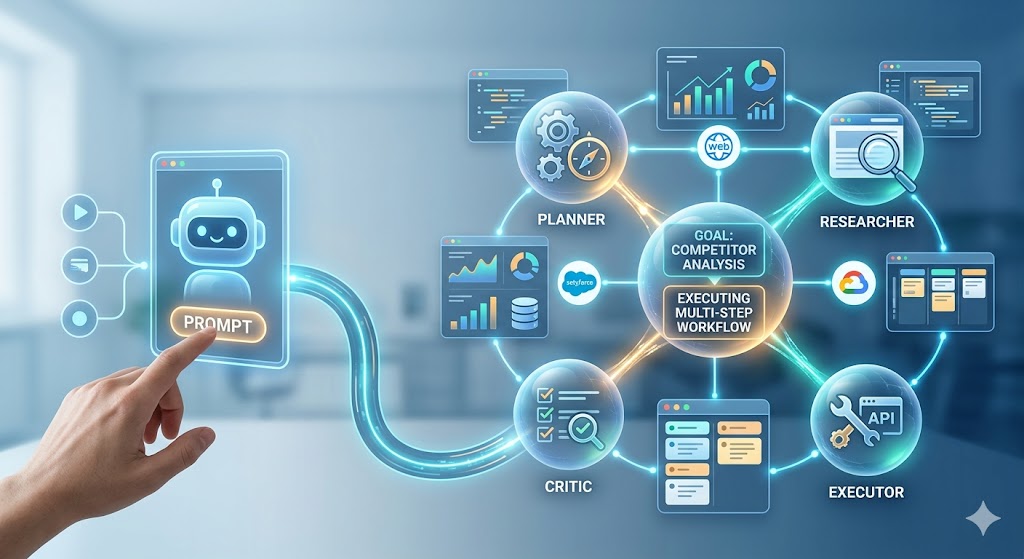
Agentic AI, on the other hand, operates on goals, not just prompts. You give an AI agent a high-level objective, and it creates its own multi-step plan, uses external tools, loops in other specialized agents, and double-checks its own work before presenting you with the finished product.
Agentic AI (noun): AI systems designed with autonomy, intent, and the ability to execute multi-step workflows across different software platforms without needing a human to guide every single step.
Instead of writing five different prompts to get one job done, you set the goal once and let the agent manage the entire pipeline.
The Core Features of an AI Agent
To understand why this is a game-changer for business productivity, look at the four unique traits that separate an AI agent from a standard chatbot:
- Autonomous Planning: When given a goal, the agent breaks it down into a logical sequence of smaller tasks. If a step fails, it pivots and tries a different approach.
- Tool Utilization: Agents aren’t trapped inside a chat window. They can browse the web, interact with databases, read APIs, update spreadsheets, and send Slack messages.
- Multi-Agent Collaboration: Complex workflows often use a team of agents. For example, a “Researcher Agent” gathers data, a “Writer Agent” drafts a report, and a “Critic Agent” reviews it for quality control.
- Self-Reflection: Before delivering the final result, an agent reviews its own output against your original goal to catch mistakes and self-correct.
Real-World Examples: How Agentic AI Works in Practice
What does this actually look like in a daily business workflow? Here is a side-by-side comparison of standard AI versus Agentic AI:
| Task | Standard AI Approach | Agentic AI Approach |
| Competitor Research | You prompt the AI to summarize one competitor website. You copy the text into a document and repeat the process manually for ten more sites. | You tell the agent: “Find our top 10 competitors, analyze their pricing pages, and build a comparison matrix in Google Sheets.” The agent handles the rest. |
| Customer Support | A chatbot answers basic FAQs. If a customer asks a complex question about a refund, the bot hands it off to a human agent. | The agent looks up the customer’s purchase history in the CRM, verifies the return policy, calculates the refund amount, processes it via Stripe, and emails the receipt. |
| Content Marketing | You use AI to generate an outline. Then you write a prompt for the intro, then another for the body, and manually upload it to your website. | A specialized team of agents researches trending keywords, drafts a comprehensive article, optimizes it for SEO, creates featured images, and schedules it in WordPress. |
How to Prepare Your Business for the Agentic Era
You don’t need a team of software engineers to start benefiting from autonomous workflows today. Here is a simple framework to make your operations agent-ready:
1. Map Your Repetitive Workflows
Look for workflows in your business that follow a predictable logic but require jumping between multiple software tools (e.g., pulling data from an email, putting it in Excel, and uploading it to a project management board). These are prime candidates for AI agents.
2. Clean Up Your Data Groundwork
AI agents are only as good as the information they can access. Ensure your internal documentation, standard operating procedures (SOPs), and customer databases are organized, clean, and up to date.
3. Adopt Agent-Friendly Tooling
Start experimenting with platforms built specifically for autonomous workflows. Tools like CrewAI, AutoGen, and LangChain are leading the development space, while user-friendly platforms are building agentic features directly into everyday project management and automation tools.
The Bottom Line: From Assistant to Teammate
Agentic AI isn’t about replacing the human element; it’s about freeing humans from digital busywork. By shifting your mindset from prompting AI to managing AI agents, you can scale your output, eliminate operational bottlenecks, and focus heavily on high-level strategy.
The businesses that adopt autonomous workflows today are the ones that will out-pace, out-publish, and out-maneuver their competition tomorrow.

![For decades, business cybersecurity was built like a medieval castle. You built a high wall (the corporate firewall), dug a deep moat (network security), and trusted anyone who managed to make it past the drawbridge. If you were inside the office network, you were deemed safe. That model is officially dead. With the permanent rise of hybrid work, data scattered across multiple clouds, and automated, AI-driven cyber threats, there is no longer a physical perimeter to defend. Attackers aren't trying to smash their way through your firewall anymore; they are simply logging in using compromised credentials. To survive this shifting threat landscape, businesses are moving away from traditional prevention and embracing cyber resilience through Identity-First Security. Here is why your identity management is your actual firewall, and how to protect your organization. The Tipping Point: Why Traditional Security Is Failing The old way of securing a business assumed a perimeter. Today, that perimeter has completely dissolved due to three undeniable shifts: AI-Weaponized Phishing and Deepfakes: Cybercriminals are leveraging generative AI to scale highly personalized phishing campaigns and bypass traditional authentication. Sophisticated deepfake audio and video are now being used to impersonate executives on live calls to trick employees into routing funds or handing over access keys. The Proliferation of Non-Human Identities (NHIs): In a modern business, human employees are no longer the only entities accessing your data. Your network is flooded with non-human identities—API keys, automated service accounts, software integrations, and autonomous AI agents. These machine identities vastly outnumber human users and are heavily targeted by hackers. Privilege Sprawl: Over time, employees and automated bots accumulate permissions they no longer need to perform their daily tasks. This "identity debt" means that if a single minor account is compromised, an attacker inherits a master key to move laterally across your entire corporate network. What is Identity-First Security? Identity-First Security is a foundational element of a Zero Trust Architecture. The core operating philosophy of Zero Trust is simple: Never trust, always verify. Instead of assuming an entity is safe because it has logged into the network before, every single access request—whether made by a remote employee, a vendor, or an internal software script—is treated as an isolated, unverified event. [Access Request] ──> [Continuous Contextual Check] ──> [Minimum Access Granted] (Device Health + Behavior) (Least Privilege Rule) In an identity-first framework, access is dynamic rather than static. It relies on continuous signal interrogation, evaluating real-time context such as device health, geolocation, and behavioral patterns before granting permission. Core Strategies to Build a Cyber-Resilient Identity Framework Shifting to an identity-first model doesn't happen overnight, but you can dramatically lower your business risk by focusing on these essential practices: 1. Enforce Phishing-Resistant MFA Traditional Multi-Factor Authentication (like standard SMS text codes or basic push notifications) can be intercepted or bypassed by modern phishing kits. Upgrading to phishing-resistant MFA—such as FIDO2 passkeys or biometric-based authentication—strips away the value of harvested passwords and keeps unauthorized users out. 2. Implement the Principle of Least Privilege (PoLP) Do not give users sweeping administrative access by default. Under a Zero Trust model, accounts are restricted to the bare minimum permissions required to execute their specific roles. If a project ends or an employee shifts duties, their access footprint should be immediately trimmed to eliminate privilege sprawl. 3. Inventory and Audit Non-Human Identities You cannot secure what you cannot see. Organizations must actively discover and catalogue every API key, webhook, and third-party software integration interacting with their systems. Treat automated bots and AI agents as first-class identities with their own strict lifecycles and restricted permissions. 4. Optimize for "Time to Remediate" Cyber resilience is built on the pragmatic assumption that a breach will eventually occur. Rather than pouring your entire budget into building higher walls, invest in fast detection and automated incident response frameworks. The ultimate metric of a resilient business is how quickly you can isolate a compromised identity, terminate its active sessions, and maintain business continuity without operational downtime. Turning Security into a Business Advantage Migrating to an Identity-First, Zero Trust framework is a strategic business advantage. Organizations with verified, resilient security postures benefit from faster compliance audits, lower cyber insurance premiums, and vastly improved customer confidence. By treating identity as your primary line of defense, you ensure that your business remains agile, scalable, and completely secure—no matter how fast the threat landscape evolves.](https://www.marathimoral.com/wp-content/uploads/2026/06/d7ac9340-97b7-4e9f-979a-dc0f294f7c31-768x419.jpg)