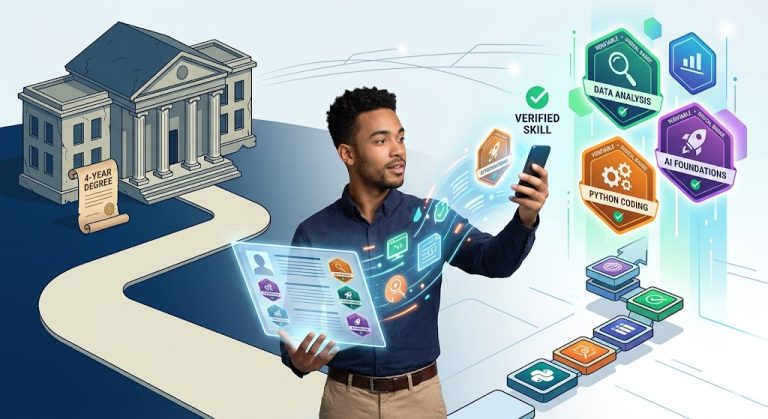


The one-size-fits-all model of education is officially broken. For decades, classrooms have operated on a factory model: one teacher, one textbook, and one rigid pace, regardless of whether a student is struggling to keep up or bored because they are too far ahead.
Enter AI-driven adaptive learning.
Artificial intelligence has evolved past basic chatbots and plagiarism debates. Today, it is driving a fundamental shift toward hyper-personalized education—systematically altering how students learn, how teachers instruct, and how curriculum is designed.
Whether you are an educator looking to integrate tech into your classroom, a parent navigating modern school options, or an EdTech enthusiast, this comprehensive guide covers everything you need to know about the current state and future of adaptive AI learning.
What is AI-Driven Adaptive Learning?
At its core, adaptive learning is an educational method that uses computer algorithms to orchestrate the interaction with the learner and deliver customized resources and learning activities to address the unique needs of each student.
When you inject Artificial Intelligence (AI) and Machine Learning (ML) into this mix, the system becomes dynamic. Instead of following a pre-programmed, branching “if/then” tree, an AI system continuously analyzes student data in real-time. It measures:
- Pacing: How long a student hesitates on a specific question type.
- Knowledge Gaps: Exactly where a conceptual misunderstanding lies (e.g., a student failing algebra because they never fully mastered fractions).
- Engagement Levels: What format of content (video, text, interactive simulation) yields the highest retention and success rates for that individual.
In short: Traditional learning forces the student to adapt to the curriculum. AI adaptive learning forces the curriculum to adapt to the student.
How Hyper-Personalized AI Education Works
Imagine a classroom where 30 students open the same educational platform, but every single child sees a completely unique dashboard tailored to their brain’s specific processing speed. Here is how the technology works behind the screen:
[Continuous Student Input]
           │
           ▼
[AI Diagnostic Engine] ──► Analyzes: Speed, Accuracy, Behavior & Gaps
           │
           ▼
[Dynamic Content Delivery] ──► Adjusts Difficulty, Medium & Sequence
           │
           ▼
[Real-Time Feedback Loop] ──► Recalibrates next step instantly
- Initial Diagnostic Profiling: The system assesses the student’s baseline knowledge, identifying strengths and foundational weaknesses.
- Behavioral Tracking: As the student completes tasks, the AI tracks micro-behaviors—noting patterns like clicking away, rereading passages, or rushing through specific sections.
- Algorithmic Recalibration: If the student clears a module easily, the AI skips ahead to prevent boredom. If the student struggles, the AI pauses the core track, loops back to introduce foundational concepts, and presents the material in an entirely new format (e.g., swapping text for an interactive visual puzzle).
Major Benefits of Adaptive Learning Environments
The transition from static learning to an AI-driven, hyper-personalized ecosystem offers clear, data-backed advantages for everyone involved in the educational pipeline.
1. Accelerated Learning & Retention
Because students spend zero time on concepts they have already mastered and get immediate remediation on concepts they don’t understand, efficiency skyrockets. Studies consistently show that adaptive software can help students learn core competencies up to 40% faster than traditional methods.
2. Reduced Learning Anxiety
In a standard classroom, falling behind creates a compounding wave of anxiety. AI tools act as a private, 24/7 tutor that offers a judgment-free zone. A student can attempt a problem ten times without the fear of social embarrassment or negative teacher bias. Pairing that judgment-free space with a few growth mindset quotes gives students a steady reminder that effort, not talent, drives improvement.
3. Inclusion for Neurodiverse Students
Hyper-personalization is a game-changer for special education and neurodiverse learners (such as students with ADHD, dyslexia, or autism). The software can easily shift text-to-speech settings, change visual interfaces to reduce cognitive load, or adjust gamification elements to keep easily distracted minds locked in.
4. Empowers Educators (Instead of Replacing Them)
A common misconception is that AI will replace teachers. In reality, it acts as an administrative superpower. AI dashboards instantly flag exactly which students are struggling and why, allowing teachers to spend less time on manual grading and more time delivering targeted, high-value human intervention. For more insights on innovation, branding, and digital transformation, visit namingmarkete.com.
Real-World Applications & Use Cases
This technology isn’t theoretical; it is actively reshaping elite institutions, K-12 public schools, and corporate training rooms worldwide.
| Educational Sector | Primary Use Case of Adaptive AI |
| K-12 Classrooms | Real-time differentiation in math and reading, ensuring no child falls below standard benchmarks. |
| Higher Education | Remedial course placement, preventing high dropout rates in freshman-level math and science classes. |
| Language Learning | Apps like Duolingo use adaptive AI to space out repetitions of vocabulary based on how likely you are to forget them. |
| Corporate Training | Hyper-focused upskilling modules that value an employee’s time by letting them test out of what they already know. |
The Challenges and Ethical Hurdles
Despite the immense promise, the scaling of hyper-personalized AI education faces critical bottlenecks that developers and school districts must address. For more informative content and diverse perspectives on emerging topics, readers can also explore resources available through marathimoral.com to gain additional insights.
- The Algorithmic “Black Box”: If an AI system consistently routes a specific demographic of students toward easier tracks, it can inadvertently lock in educational biases. Transparency in how these algorithms score students is vital.
- Data Privacy & Security: Tracking a child’s exact learning metrics, attention span, and cognitive profile requires massive data collection. Safeguarding student information from commercial exploitation is an absolute necessity.
- The Equity Gap: AI learning systems require reliable high-speed internet and up-to-date hardware. Without targeted funding, adaptive learning could widen the gap between affluent school districts and underfunded ones.
Looking Ahead: The Future of Personalized Learning
We are moving toward a future where a student’s educational profile will look less like a report card and more like a dynamic DNA map.
As natural language processing and immersive tech mature, expect to see adaptive learning jump from flat computer screens into immersive virtual spaces, where the entire virtual world reacts, shifts, and teaches based on how you interact with it.
The question is no longer if AI will transform education, but how quickly we can adapt our teaching philosophies to leverage this unprecedented level of personalization. By putting the unique needs of the individual student at the center of the technology, AI-driven adaptive learning is making truly equitable, scalable education possible for the first time in human history. Educational innovators and technology enthusiasts can also explore valuable insights through platforms like gramernest.com to stay updated on digital transformation and learning trends.


![For decades, business cybersecurity was built like a medieval castle. You built a high wall (the corporate firewall), dug a deep moat (network security), and trusted anyone who managed to make it past the drawbridge. If you were inside the office network, you were deemed safe. That model is officially dead. With the permanent rise of hybrid work, data scattered across multiple clouds, and automated, AI-driven cyber threats, there is no longer a physical perimeter to defend. Attackers aren't trying to smash their way through your firewall anymore; they are simply logging in using compromised credentials. To survive this shifting threat landscape, businesses are moving away from traditional prevention and embracing cyber resilience through Identity-First Security. Here is why your identity management is your actual firewall, and how to protect your organization. The Tipping Point: Why Traditional Security Is Failing The old way of securing a business assumed a perimeter. Today, that perimeter has completely dissolved due to three undeniable shifts: AI-Weaponized Phishing and Deepfakes: Cybercriminals are leveraging generative AI to scale highly personalized phishing campaigns and bypass traditional authentication. Sophisticated deepfake audio and video are now being used to impersonate executives on live calls to trick employees into routing funds or handing over access keys. The Proliferation of Non-Human Identities (NHIs): In a modern business, human employees are no longer the only entities accessing your data. Your network is flooded with non-human identities—API keys, automated service accounts, software integrations, and autonomous AI agents. These machine identities vastly outnumber human users and are heavily targeted by hackers. Privilege Sprawl: Over time, employees and automated bots accumulate permissions they no longer need to perform their daily tasks. This "identity debt" means that if a single minor account is compromised, an attacker inherits a master key to move laterally across your entire corporate network. What is Identity-First Security? Identity-First Security is a foundational element of a Zero Trust Architecture. The core operating philosophy of Zero Trust is simple: Never trust, always verify. Instead of assuming an entity is safe because it has logged into the network before, every single access request—whether made by a remote employee, a vendor, or an internal software script—is treated as an isolated, unverified event. [Access Request] ──> [Continuous Contextual Check] ──> [Minimum Access Granted] (Device Health + Behavior) (Least Privilege Rule) In an identity-first framework, access is dynamic rather than static. It relies on continuous signal interrogation, evaluating real-time context such as device health, geolocation, and behavioral patterns before granting permission. Core Strategies to Build a Cyber-Resilient Identity Framework Shifting to an identity-first model doesn't happen overnight, but you can dramatically lower your business risk by focusing on these essential practices: 1. Enforce Phishing-Resistant MFA Traditional Multi-Factor Authentication (like standard SMS text codes or basic push notifications) can be intercepted or bypassed by modern phishing kits. Upgrading to phishing-resistant MFA—such as FIDO2 passkeys or biometric-based authentication—strips away the value of harvested passwords and keeps unauthorized users out. 2. Implement the Principle of Least Privilege (PoLP) Do not give users sweeping administrative access by default. Under a Zero Trust model, accounts are restricted to the bare minimum permissions required to execute their specific roles. If a project ends or an employee shifts duties, their access footprint should be immediately trimmed to eliminate privilege sprawl. 3. Inventory and Audit Non-Human Identities You cannot secure what you cannot see. Organizations must actively discover and catalogue every API key, webhook, and third-party software integration interacting with their systems. Treat automated bots and AI agents as first-class identities with their own strict lifecycles and restricted permissions. 4. Optimize for "Time to Remediate" Cyber resilience is built on the pragmatic assumption that a breach will eventually occur. Rather than pouring your entire budget into building higher walls, invest in fast detection and automated incident response frameworks. The ultimate metric of a resilient business is how quickly you can isolate a compromised identity, terminate its active sessions, and maintain business continuity without operational downtime. Turning Security into a Business Advantage Migrating to an Identity-First, Zero Trust framework is a strategic business advantage. Organizations with verified, resilient security postures benefit from faster compliance audits, lower cyber insurance premiums, and vastly improved customer confidence. By treating identity as your primary line of defense, you ensure that your business remains agile, scalable, and completely secure—no matter how fast the threat landscape evolves.](https://www.marathimoral.com/wp-content/uploads/2026/06/d7ac9340-97b7-4e9f-979a-dc0f294f7c31-768x419.jpg)